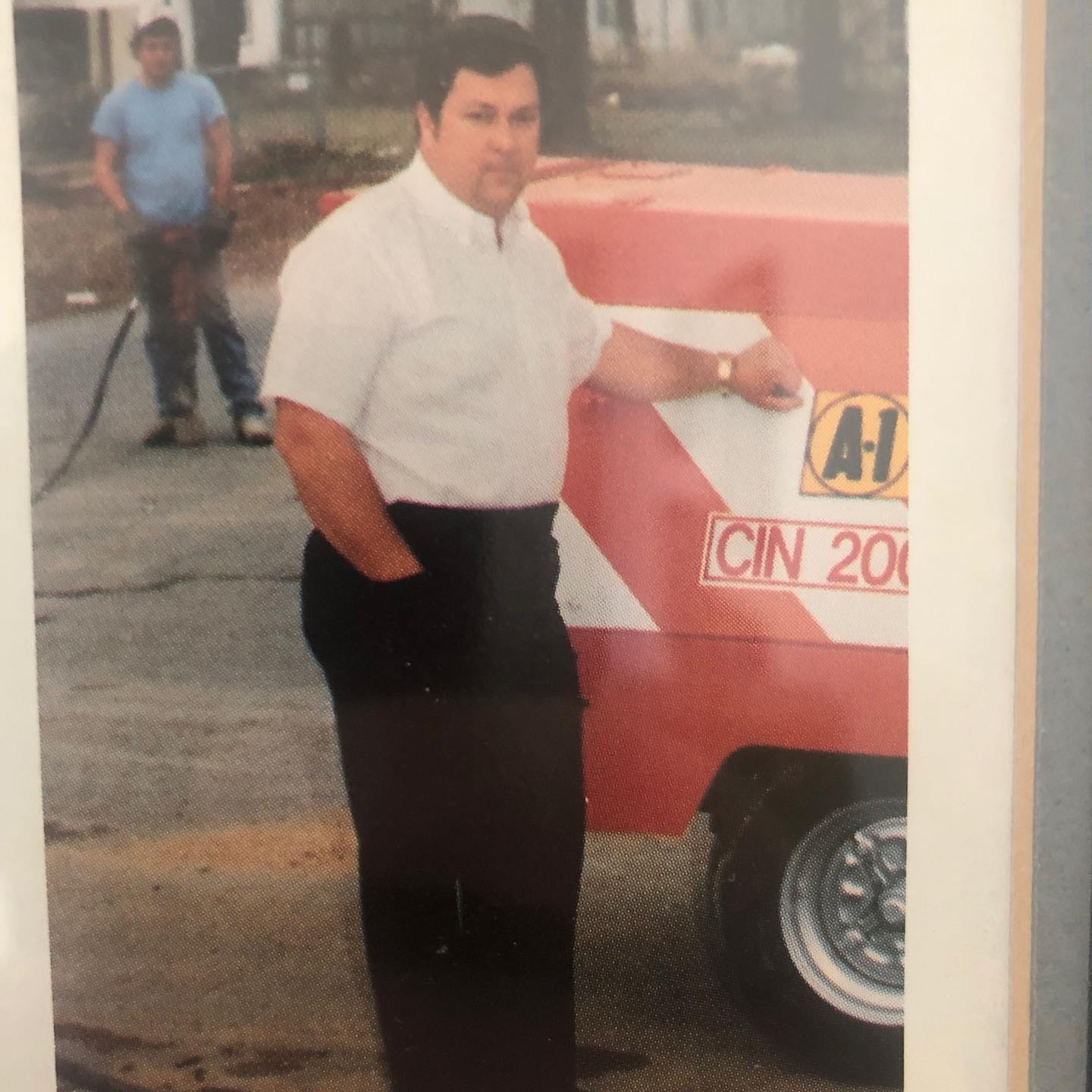
There is no shortage of places to look for examples of good leadership. Every CEO and politician (and leadership coach) seems to be putting out an endless stream of tips for great leadership. To me, a lot of this advice falls flat, and I think it has a lot to do with the business owner that I knew the longest: my dad, Stan.
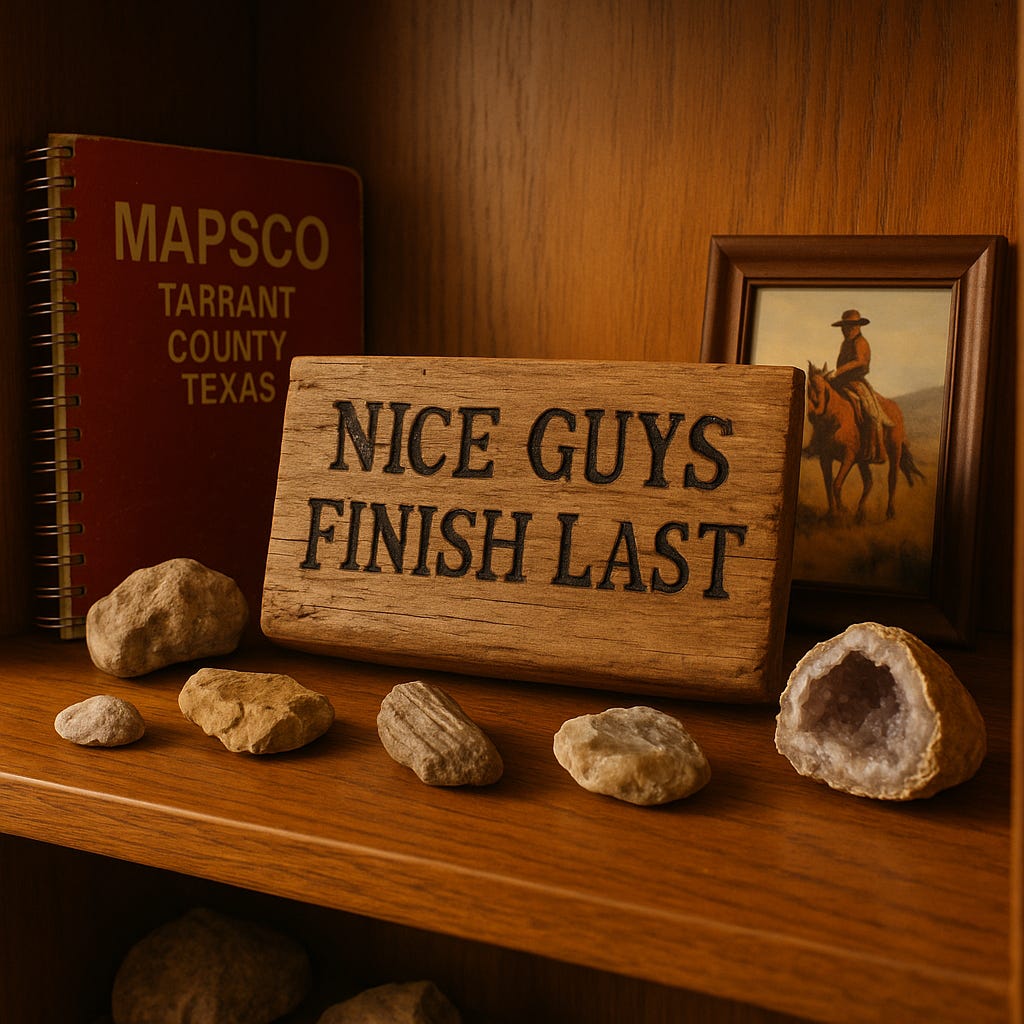
My dad’s office had some things you’d expect to see if you knew him: some western art, lots of “cool rocks” like geodes and fossils and petrified wood, and a spiral-bound Mapsco with pages that showed every street in Tarrant County. One of the things that definitely looked out of place, however, was a sign on a shelf that simply said “Nice Guys Finish Last.” If you knew my dad, you would know that he had a reputation for being a nice guy. Warm, generous, funny, and fair. Did he really think he was finishing last?
Stan Yeats ran Yeats Contracting Company, a small contractor that specialized in doing road repairs for utility companies in Fort Worth. When the gas company or electric company or phone company would tear up part of a street to do work on the utility lines, YCC would come by afterward and add an asphalt or concrete patch to get the traffic lanes open again.
The story behind the “Nice Guys Finish Last” sign, as I understand it, was that a friend of dad’s, maybe a fellow entrepreneur or business owner, told him that he would never get ahead in business if he kept going out of his way to be nice all the time. As a joke, he gave Stan the sign. Instead of hiding it someplace or tossing it in the dumpster out in the equipment yard, dad displayed it in a prominent place in his office. He welcomed the “nice guy” label.
I have had many opportunities over my career to be a business owner, boss, manager, mentor, coach, teacher, and leader, and I am eternally grateful that I was influenced early on by my dad’s example. However, the type of leadership that I see being promoted and often even celebrated in news tends to be the Steve Jobs model of a maniacal visionary who aggressively holds employees to the highest standards. I don’t think I’ve once heard anyone say that Steve Jobs or Elon Musk is nice. When I see this kind of celebration of harshness and callousness, it makes me think about what it means to choose to be nice.
Being Nice is Not a Liability, It’s an Asset
Despite what the behavior of many celebrated titans of business might suggest, being a nice boss does not doom leaders to fail. Instead, I would argue that being nice is a fundamental attribute of effective leadership. In order to be even more precise, however, I tend to prefer using the word benevolent rather than nice.
In my experience of leading teams or collaborating with peers or teaching students, I have (probably instinctively) always approached the task of building relationships as a required precursor to being influential in working with others. In a nutshell, in order to lead, you first have to establish and nurture trust.
Luckily, it only takes a bit of unpacking of the concept of trust to get back to benevolence. Scholars and academics who write about trust break down the concept into three components: 1) competence (sometimes referred to as ability), 2) benevolence, and 3) integrity (sometimes simplified to honesty). There are plenty of references to this model of trust. (Here’s an article from the Northwestern’s Kellogg School of Management as an example.)
To be benevolent, you have someone else’s best interests at heart and care about them as a person. As a leader, boss, coach, mentor, or teacher, you can’t earn trust without truly caring about those people you’re working with and doing things that put them first—sometimes even putting your own self-interest aside to look out for them.
In The Manager’s Playbook, Joel Trammell and Alicia Thrasher put it this way:
Only when employees believe you to be competent, credible, and caring will you have real influence with them—and be able to effectively use the tool of leadership.
I love how Joel, a successful CEO himself and a coach to other CEOs, thinks of leadership as a caring profession.
Nice to Employees, but Cruel to Competitors, Right?
You might be thinking to yourself that a great leader can’t possibly be nice to everyone. What about crushing the competition? What about pushing others down to gain market share? What about driving others out of business?
For me, the most inspirational way to think about these questions comes from a story about Sarah Blakely, the founder of Spanx. Sarah is a billionaire entrepreneur who rejects the idea that you have to be aggressive about killing the competition. Instead, she said:
I have not been obsessed or focused on the competition and annihilating the competition. I have only been focused on my own quality. What can I offer that’s the best and give value?
In other words, she does not have to reject the idea of benevolence in order to be a successful business person. Instead, she extends it to her own customers. I can see Sarah asking herself, “What is best for my customers?” as a way to guide her business forward. A lot more benevolent than “How do I hurt my competition?"
Unhealthy competitive behaviors aren’t just external to organizations. They also seep into internal conflicts. Institutional politics can lead down a path of tribalism where teams are looking to sabotage each other while striving for more prestige within the company or attention from executives. This corrosive ambition is a choice, and corporate leaders are culpable when they support it—even when the support is just tacitly allowing individual ambition to run unchecked.
There’s absolutely no evidence that choosing to be aggressive, harsh, and cruel is a good way to run a company or lead a group of people. Success is not just for sadists.
When Nice Goes Bad
As with everything, there has to be a balance for the kindness, caring, and benevolence a leader shows. That’s why the model of trust is so important. If a leader is being nice and kind only to be well liked or be everyone’s friend, then it starts to erode the other two components of trust (and leadership): competence and integrity.
If a leader only tells others what they want to hear, then they lack integrity. Giving people empty compliments or being agreeable doesn’t signal to them that you’re honest and transparent. It can erode trust if benevolence isn’t balanced with honesty.
If a leader gives a promotion to someone who doesn’t deserve it or someone who doesn’t have the skills to succeed in their job, then they aren’t competent in being a leader. They fail the entire organization chasing the acceptance of a single employee. It can erode trust if benevolence isn’t balanced with competence.
Leaders must resist being people-pleasers. If they don’t, they risk avoiding tough conversations, procrastinating on difficult decisions, and tolerating bad behavior or poor performance from their team.
Be Kind
Far too many leaders believe that they are exempt from being kind or benevolent or nice if they are pursuing wealth, power, or fame. They believe that the ends justify the means—that only the outcomes matter. To them, winning means never being held accountable for the way they treat others. But, in reality, they have a choice. They can be kind, or they can be cruel. They can be benevolent, or they can be greedy, hateful, and mean.
I, for one, choose to be nice. Being nice is not weak. Being nice is not ineffective. It is a fundamental part of being trusted and having influence.
The only thing I do know... is that we have to be kind.
-Waymond in Everything Everywhere All at Once
Remembering Stan
As I’m writing this, I’m approaching the 5-year anniversary of Stan’s passing. And, I’m happy to report that Stan didn’t finish last—not by a long shot. His funeral was attended by a huge number of friends, family, former employees, and colleagues who spoke of him fondly and recalled specific instances of Stan’s benevolence and kindness. While he did not prioritize amassing wealth to pass on to future generations, he did give me something worth much more than material things: he helped instill in me a value system that is based on serving others and working to achieve a positive outcome for all. For that, I am eternally grateful.